
Pakistan's Defence Minister Chaudhry Ahmed Mukhtar has said that the Pakistan People's Party-led government was not giving any extension to Chief of Army Staff General Ashfaq Parvez Kayani, as he has not asked for the extension of his tenure.

Pakistan Army chief General Ashfaq Parvez Kayani has "learned the lesson" of his predecessor General Pervez Musharraf and prefers staying behind the scene while manipulating the government's decision-making on key issues, according to secret American documents released by WikiLeaks.
The United States has ruled out a military coup in Pakistan in the wake of the political chaos saying Army Chief General Ashfaq Kayani is a staunch supporter of democracy and doesn't want to take over like his predecessor Pervez Musharraf did in 1999.

Several retired and serving military officers attend Pervez Musharraf's funeral prayers.
Pakistan Muslim League - Q chief Chaudhry Shujaat Hussain has emerged as a mediator between Prime Minister Yusuf Raza Gilani and army chief General Ashfaq Parvez Kayani after differences between Pakistan's civilian government and the powerful military seemed to reach at point of no return. Hussain, who served as prime minister during Pervez Musharraf's reign, is considered to be close to the security establishment and is known for his links with the armyThe lead

Pakistan's former army chief Gen Pervez Musharraf kept Gen Ashfaq Parvez Kayani in the dark about Kargil Operation in 1999 despite the latter heading forces responsible to guard (Pakistan-occupied) Kashmir, according to a new book by a former general.

Pakistan Army chief General Ashfaq Parvez Kayani had expressed doubts about a claim by the regime of his former boss Pervez Musharraf that Benazir Bhutto was assassinated by the Pakistani Taliban, a United Nations investigator has said.
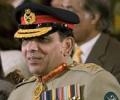
Prime Minister Nawaz Sharif plans to name Pakistan's new army chief weeks before Gen Ashfaq Parvez Kayani's term ends in November to quell speculation about the issue, according to a media report on Monday.
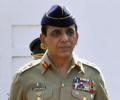
The name of Pakistan Army chief Gen Ashfaq Parvez Kayani's successor will be announced a day before he retires on November 29, Information Minister Pervaiz Rashid said on Friday.
Pakistan's hawkish Army chief Gen Ashfaq Parvez Kayani, who did little to change the force's India-centric stance, will leave the world's sixth-largest army grappling with a host of security challenges when he steps down on Friday.
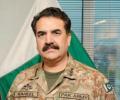
Ending weeks of speculation, Prime Minister Nawaz Sharif on Wednesday appointed Lt Gen Raheel Sharif as Pakistan's new army chief and Lt Gen Rashid Mehmood as the chairman joint chiefs of staff committee.

In his latest book 'Playing to the Edge', Michael Hayden, the former CIA director said that Pasha had conceded that some of the powerful spy agency's retired members were engaged in training those involved in the heinous crime but refused to take action.
'Pakistan's army has got a streak of democracy. It is more democratic than the country.'

With Pakistan's powerful army chief Gen Ashfaq Parvez Kayani's term coming to an end in November, names of top generals who are likely to succeed him are being discussed in the political circles and in the corridors of power.

'Pakistan's only concern has been while they were on the FATF watch list was to distance their State institutions and organs from any direct connection with the actual execution of militancy inside Kashmir.'

If General Asim Munir, Pakistan's new army chief, wants to help defuse the current polarised atmosphere and shepherd civilian politicians towards negotiations on an acceptable date for elections, he may need to distance himself from any perception of needless hostility to Imran Khan, explains Rana Banerji, who headed the Pakistan desk at RA&W, India's external intelligence agency.
Emerging reports from Pakistan suggest that Pakistan President Pervez Musharraf might opt to step down in the wake of a meeting with the Army chief though the President himself denied the news. Musharraf held a meeting with army chief Gen Ashfaq Parvez Kayani at the Army House in Rawalpindi on Wednesday night that lasted over three-and-half hours.
Pakistan President Asif Ali Zardari had wanted to retain military ruler Pervez Musharraf's close aide Tariq Aziz as a key Pakistani interlocutor for India but the move was opposed by Army Chief Gen Ashfaq Parvez Kayani, a United States diplomatic cable released by WikiLeaks has said.
The international community, including India, must offer the Pakistan government all the help and encouragement that it needs to fight and root out the menace of radical extremism, or else the terrorists will spread their tentacles far and wide -- including, eventually, into India.

Lt Gen Haroon Aslam of the Pakistan Army on Thursday resigned a day after he was superseded by his two juniors who were made the new army chief and the chairman joint chief of staff committee.

After Modi became the prime minister, the Indo-US relationship has seen an upward trajectory, he said.

General Asad Durrani's disclosures could leave considerable egg on the face of those currently wielding the stick in Pakistan, notes Rana Banerji, who headed the Pakistan desk at the Research and Analysis Wing, India's external intelligence agency.

Lt Gen Zubair Hayat appointed as Chairman of Joint Chief of Staff Committee.
With its new army chief Gen Qamar Javed Bajwa set to take charge, Pakistan has asserted that focus will remain on country's eastern border with India, even as the US nudged Islamabad to keep the pledge of not allowing use of its soil for terror attacks against neighbours.

Gen Sharif had earlier promised to bow out at the end of his term in November this year.

Pervez Musharraf said that Pakistan tried to undermine the Afghan government led by ex-president Hamid Karzai for helping "India stab Pakistan in the back".
India must watch for signs after Peshawar that Pakistan is waking up to the dangers of Islamism, muses Ajai Shukla
'Already, there is talk of a possible extension for Raheel Sharif in the context of his perceived sterling, but incomplete work in the war against terror, as also the cleansing of crime and extortion networks in Karachi,' says Rana Banerji.

General Qamar Bajwa, his colleagues say, is a firm opponent of extremism and terrorism. He may prove even more forceful in the fight against terrorism than his predecessor, who is credited with launching Operation Zarb-i-Azb, which helped lower the frequency of terrorist attacks.
'It is not difficult for a Pakistan army chief assisted by the deep state to manipulate a situation.' 'Pulwama, Uri and Pathankot, all come to mind,' cautions Lieutenant General Syed Ata Hasnain (retd).
'A close look at the time-lines tells you that exactly as the back-channel negotiations were in their most crucial stage, "somebody" was planning the 26/11 attacks in Mumbai,' says Shekhar Gupta questioning Khurshid Mahmud Kasuri's account of a peace deal with India.
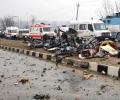
'A resurgent Jaish could be a reflection of the Pakistani security establishment's view that with the region moving ever closer to a post-US Afghanistan, it is time to redirect attention to Kashmir.'
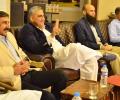
'Over the last year, Bajwa has created the environment to support bold moves on India. The ball is in India's court,' a senior Pakistan military officer tells Ajai Shukla.
.jpg)
Pundits in Pakistan and also some western diplomats are predicting that the next army chief will be forced, partly by institutional pressure and partly by circumstances, to indulge in some tough talking with the civilian leadership. How the civil-military equation settles in this sort of a situation is something that will determine the future of Pakistani politics, and also Pakistan's relations with rest of the world, says Sushant Sareen.
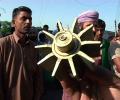
New Delhi's decision not to call for a flag meeting underlines its conviction that the military cost will soon become too high for Pakistan.
'General Bajwa is believed to consider the internal threats to Pakistan's security as far more serious than the bogey of the Indian threat.' 'This doesn't mean that he is soft on India, only that he is more rational and sensible than his predecessor who had a bit of a chip on his shoulder about India,' points out Pakistan expert Sushant Sareen.
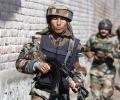
'After General Raheel Sharif took on the Tehrik-e-Taliban Pakistan, some sections of the military establishment may have felt unease as to whether the crackdown could be extended against friendlier 'non-State' actors like the Lashkar-e-Tayiba.'
Through its early days to the 1980s, Pakistan sought to expand its sphere of Islamic influence through Afghanistan to Central Asia and got Pakistani citizens recruited in the Afghan government institutions in the 1990s when the Taliban were power. Now, it is looking eastward through India to Bangladesh and Myanmar to establish an imaginary caliphate.
